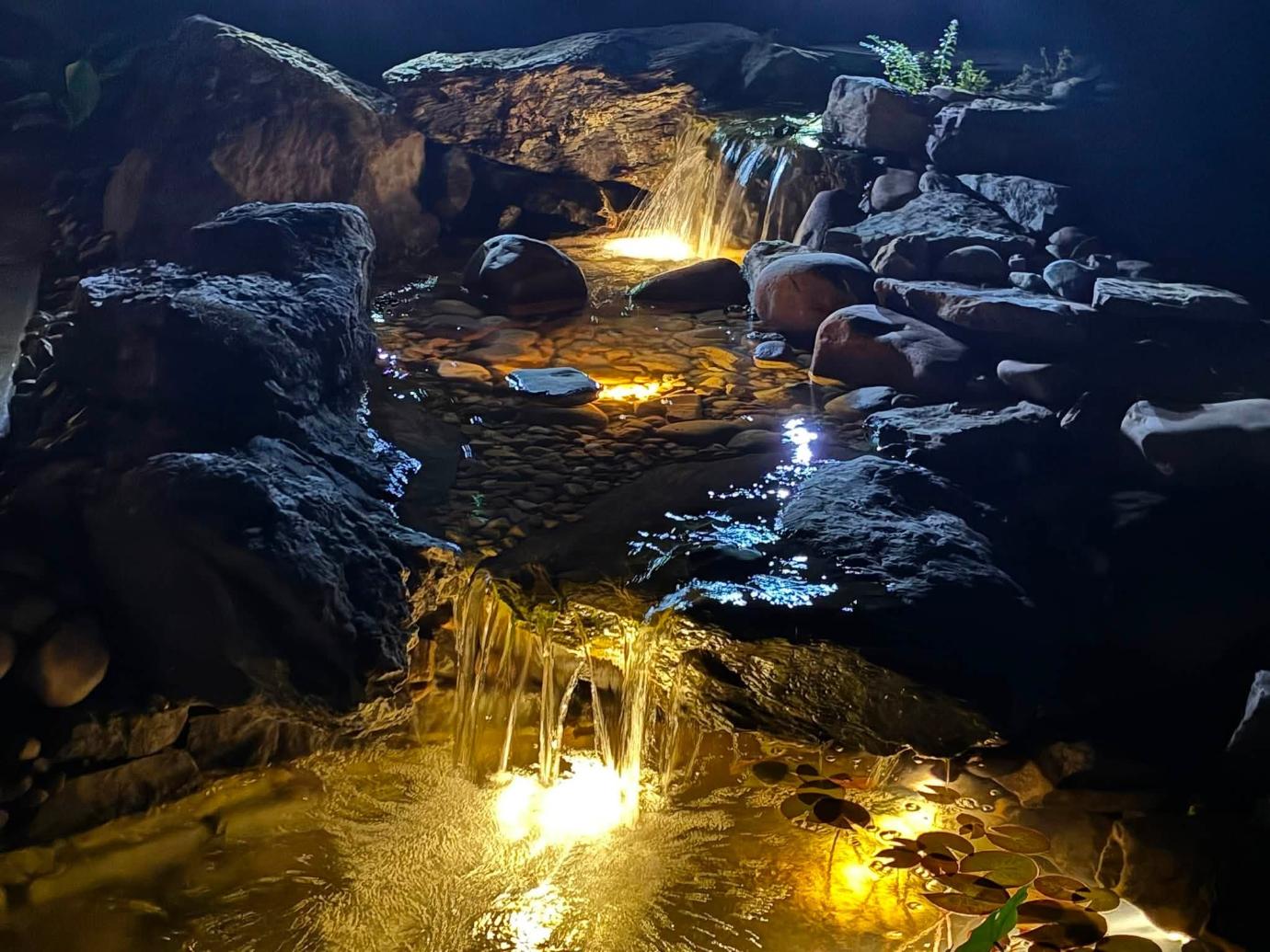
A custom waterfall can turn an ordinary backyard into a quieter, more inviting outdoor space, but successful design involves much more than stacking stone around a pump. In Madison County, rainfall, drainage, existing grades, mature landscaping, and the way a property is used all influence where a water feature should go and how it should be built.
A well-designed waterfall should fit the landscape naturally, move water reliably, and remain practical to maintain. Before installation, homeowners should consider the feature’s location, elevation changes, water circulation, drainage, surrounding plants, viewing angles, and relationship to patios or outdoor living areas. The best design feels connected to the property rather than added as an afterthought.
What local homeowners should know
-
A waterfall should be positioned where it can be enjoyed from the areas you use most, such as a patio, porch, pool deck, or interior living space.
-
Drainage deserves special attention on Madison County properties because heavy rainfall can change how water moves across a yard.
-
Properties in Madison, Ridgeland, Canton, Gluckstadt, and Flora can have different grades, lot sizes, and surrounding landscape conditions that affect design.
-
Pump access, filtration, electrical needs, and routine cleaning should be considered before stonework makes equipment difficult to reach.
-
The scale of the waterfall should complement the home and landscape rather than overwhelm a smaller backyard or disappear within a large property.
Jerry Spencer & Associates approaches custom water features as part of the overall landscape. We consider how the waterfall will look, sound, function, and connect with the surrounding outdoor environment.
Why Does Waterfall Design Matter in Madison County?
Waterfall design matters in Madison County because local landscapes must manage periods of substantial rainfall while also performing through hot Mississippi summers. A water feature needs a location, grade, circulation system, and surrounding landscape that work together so stormwater, soil conditions, and normal evaporation do not create unnecessary maintenance problems.
The region includes everything from established neighborhoods in Madison and Ridgeland to larger properties near Canton and Flora. Some landscapes are relatively compact and formal, while others have broad lawns, wooded edges, slopes, or naturalistic planting areas.
That variety makes site-specific design important.
A waterfall beside a formal patio may benefit from clean lines and controlled planting. On a larger wooded property, irregular stone, layered planting, and a winding stream can create a more natural appearance. Near the Ross Barnett Reservoir area, homeowners may also prefer water features that visually complement the region’s established relationship with outdoor recreation and water.
What Do Local Soil and Drainage Conditions Mean for a Water Feature?
Local soil and drainage conditions affect how the area around a waterfall handles both normal circulation and rainfall, so proper grading and drainage should be planned before construction begins. Mississippi State University Extension advises that clay or compacted soils may drain slowly and can require additional drainage measures in landscape applications.
That does not mean every property has the same soil.
Instead, the actual installation area should be evaluated for existing drainage patterns, low spots, slopes, runoff from roofs, irrigation, and water movement during storms.
A waterfall should not unintentionally redirect runoff toward a foundation, patio, neighboring property, or other sensitive area. Proper design can also help keep surrounding beds from remaining excessively wet after storms.
How Does a Custom Waterfall Affect Your Outdoor Living Space?
A custom waterfall can make an outdoor living space feel more established by providing movement, sound, visual interest, and a focal point that can be enjoyed from multiple parts of the property. In Madison County, it can also help connect patios, pools, gardens, and shaded seating areas into one cohesive landscape.
Sound is especially important.
A taller drop or greater water volume usually creates a stronger sound, while water moving over several smaller ledges can produce a gentler effect. The desired experience should help determine the waterfall’s height, width, stone arrangement, and flow.
Viewing angles matter too. If most evenings are spent on the back porch, the best location may not be the center of the lawn. The feature should reward the places where people actually spend time.
What Are the Warning Signs of a Poorly Planned Waterfall?
Warning signs of a poorly planned waterfall include persistent water loss, standing water around the feature, difficult equipment access, excessive splash, visible liner, unstable stone, and a design that appears disconnected from the surrounding landscape. These problems often trace back to decisions made before or during installation.
Watch for:
-
Water repeatedly collecting around the waterfall after operation or rainfall
-
Soil erosion near the feature or along its drainage path
-
Water splashing outside the intended basin
-
A pump that is difficult to inspect or service
-
Rocks shifting or settling noticeably
-
Plants remaining constantly saturated near the edge
-
Frequent unexplained drops in water level
-
A waterfall that looks oversized or undersized for the space
Catching design problems early can make correction easier than waiting until erosion or settling affects a larger portion of the landscape.
When Should You Call a Professional for Waterfall Installation?
You should call a professional when a waterfall requires excavation, significant grading, electrical service, substantial stone placement, drainage modifications, or integration with an existing landscape. Professional design is particularly useful when a Madison County property has slopes, drainage concerns, established trees, irrigation, or multiple outdoor living features to coordinate.
Homeowners can safely begin by thinking about appearance and use.
Identify where you want to see the waterfall, how prominent you want the sound to be, and whether you prefer a formal or natural style. You can also observe the proposed area during rainfall to understand where water currently travels.
Installation becomes more complex once excavation, circulation equipment, utilities, structural stone, and drainage enter the picture.
What Are the Most Common Waterfall Design Challenges in Madison County?
The most common waterfall design challenges in Madison County involve drainage, scale, elevation, equipment placement, and blending the feature into an existing landscape. Hot weather, intense rain events, established plantings, and varied property grades can all affect how a custom water feature performs after installation.
1. Poor drainage planning: Runoff from surrounding areas can overwhelm the installation zone or create muddy conditions.
2. Incorrect scale: A small feature may disappear on a broad property near Flora or Canton, while an oversized waterfall can dominate a compact residential yard.
3. Insufficient elevation: A convincing waterfall needs enough grade to create the intended movement and sound.
4. Difficult equipment access: Pumps and other components should remain serviceable without dismantling decorative elements.
5. Unnatural transitions: Stone, plants, and grade changes should help the waterfall look connected to the property.
How Can You Maintain a Custom Waterfall?
Maintaining a custom waterfall means regularly checking water levels, removing debris, monitoring circulation, keeping accessible components clean, and watching the surrounding landscape for erosion or drainage changes. Madison County homeowners should pay particular attention after storms and during hot periods when conditions around the feature can change quickly.
Leaves and organic debris can accumulate, especially on wooded properties or landscapes with mature trees. Keeping debris from building up helps preserve circulation and appearance.
Homeowners can also periodically look for unusual water loss, shifting stone, clogged areas, or changes in the sound of the pump.
Electrical problems, major leaks, unstable stonework, and significant drainage issues are better evaluated professionally.
What Results Should You Expect From a Professionally Designed Waterfall?
A professionally designed waterfall should look proportionate to the property, circulate water effectively, provide the desired sound and movement, and fit naturally into the surrounding landscape. Homeowners should also expect practical access for routine maintenance and thoughtful consideration of drainage, viewing areas, planting, and existing outdoor features.
The finished feature should not have to be dramatic to be successful.
For some Ridgeland or Madison properties, a compact waterfall beside a patio may create exactly the right focal point. A larger property may support a longer stream, multiple cascades, or a broader arrangement of stone and planting.
The goal is a feature designed for the specific site.
What Mistakes Should Homeowners Avoid?
The biggest waterfall installation mistakes are choosing a location based only on appearance, ignoring drainage and maintenance access, and selecting a design that does not match the scale of the property. Avoiding these mistakes helps Madison County homeowners create a feature that remains attractive and manageable after the initial installation.
Mistake: Choosing the lowest spot in the yard simply because water already collects there.
Consequence: Stormwater may overwhelm the surrounding area.
Better approach: Evaluate existing drainage before determining placement.
Mistake: Hiding all equipment without considering access.
Consequence: Routine maintenance becomes unnecessarily difficult.
Better approach: Conceal components while keeping service points accessible.
Mistake: Using too many different stone styles.
Consequence: The waterfall can look artificial or disconnected.
Better approach: Choose materials that complement the home and surrounding hardscape.
Mistake: Designing only for the view from the yard.
Consequence: The feature may barely be visible from the porch or interior.
Better approach: Consider important viewing angles before finalizing placement.
What Is a Common Local Waterfall Design Scenario?
A common Madison County waterfall scenario involves a homeowner with an established patio and landscaped backyard who wants more movement and sound without sacrificing a large amount of usable lawn. In that situation, a compact cascade positioned along the edge of the outdoor living area may provide a better solution than placing a large feature in the center.
The waterfall could use existing grade where appropriate, with planting and stone helping visually connect it to nearby beds.
This is a general local scenario, not a specific completed project. Every property should be evaluated individually.
What Services Can Support a Custom Waterfall Project?
Services that support a custom waterfall project can include landscape planning, site preparation, grading, water feature installation, stone placement, planting, and integration with surrounding outdoor spaces. Combining these elements into one coordinated design helps the feature feel like a permanent part of the landscape rather than a separate backyard accessory.
At Jerry Spencer & Associates, we can help homeowners consider how a water feature relates to the larger landscape and outdoor living plan.
Should You Choose DIY or Professional Waterfall Installation?
DIY installation can work for very small, straightforward water features, while professional installation is better suited to custom waterfalls involving grading, excavation, heavy stone, utilities, drainage, or integration with an established landscape. The more visible and permanent the feature will be, the more valuable detailed planning becomes.
A small prefabricated fountain and a custom landscape waterfall are very different projects.
If the objective is a permanent feature that looks integrated with a home, patio, pool, or garden, professional planning can address details that are difficult to change after construction.
Where Do We Design Water Features in the Area?
Water feature design can serve homeowners throughout Madison County and surrounding communities where site conditions support an appropriate installation. This includes properties in and around Madison, Ridgeland, Canton, Gluckstadt, and Flora, with each location requiring an individual look at the landscape, drainage, and intended outdoor use.
Larger rural properties and more compact neighborhood lots may require very different approaches, even when the desired appearance is similar.
What Happens When Waterfall Problems Are Ignored?
Ignoring waterfall problems can allow minor drainage, leakage, erosion, equipment, or settling issues to become more difficult to correct. In Mississippi’s wet periods, uncontrolled water movement around a feature can also affect nearby soil and planting beds, making early evaluation a practical way to protect the surrounding landscape.
A change in water level or minor debris accumulation is not always an emergency. Persistent water loss, unstable stone, recurring erosion, electrical concerns, or water moving toward structures deserves more attention.
FAQ
How large should a waterfall be for a Madison County backyard?
The right waterfall size depends on the available space, home scale, viewing distance, desired sound, and surrounding landscape. A compact residential lot may look best with a modest cascade, while a larger Madison County property may accommodate several drops, a stream, or a wider water feature without overwhelming the landscape.
Where is the best place to install a waterfall in Madison, MS?
The best location is usually where the waterfall can be seen and heard from the outdoor areas you use most while still allowing suitable drainage, excavation, utilities, and maintenance access. In Madison, that may mean positioning the feature near a patio, pool area, garden, or visible portion of the backyard.
Can heavy rain affect a waterfall in Madison County?
Yes, heavy rainfall can affect drainage around a landscape waterfall even though the feature itself uses a recirculating water system. The surrounding grade should direct stormwater appropriately so runoff does not wash soil into the feature, erode nearby beds, or collect where it could create maintenance problems.
Can a waterfall be added to an existing Ridgeland landscape?
Yes, a waterfall can often be incorporated into an established Ridgeland landscape when there is appropriate space for excavation, circulation equipment, drainage, stone, and access. Existing patios, trees, irrigation, planting beds, and utilities should all be considered so the new feature complements rather than disrupts the property.
Do custom waterfalls require a lot of maintenance?
Custom waterfalls require routine maintenance, but the amount depends on their size, surrounding vegetation, equipment, and design. Typical homeowner tasks include removing leaves, checking water levels, monitoring circulation, and watching for unusual water loss. Landscapes with mature trees may require more frequent debris removal during seasonal leaf drop.
Can a waterfall work on a flat property in Gluckstadt?
Yes, a waterfall can be created on a relatively flat Gluckstadt property by building the elevation needed for water to descend naturally through the feature. The added grade must be designed carefully so the finished waterfall looks appropriate for the landscape and does not create unwanted drainage patterns around the installation.
What type of stone should be used for a natural-looking waterfall?
A natural-looking waterfall generally benefits from a coordinated selection of stone with varied sizes rather than many unrelated materials. Larger stones can establish the main structure, while smaller stone helps soften transitions. Material selection should also complement existing patios, retaining walls, architecture, and the broader character of the landscape.
Should landscaping be planned before or after the waterfall?
Landscaping and the waterfall should ideally be planned together because plants help soften stone edges, frame views, and connect the feature to the surrounding property. Coordinated planning also reduces the risk of putting plants where maintenance access is needed or choosing species poorly suited to conditions immediately around the water.
Create a Water Feature That Belongs in Your Landscape
A successful waterfall should look as though it was planned with the property from the beginning. By considering drainage, scale, sound, circulation, stone, planting, and outdoor living areas together, Madison County homeowners can create a water feature that adds lasting interest to the landscape.
Bring the Sound and Movement of Water to Your Madison County Landscape
We can help you explore a custom waterfall design that fits your property, outdoor spaces, and overall landscape goals.